
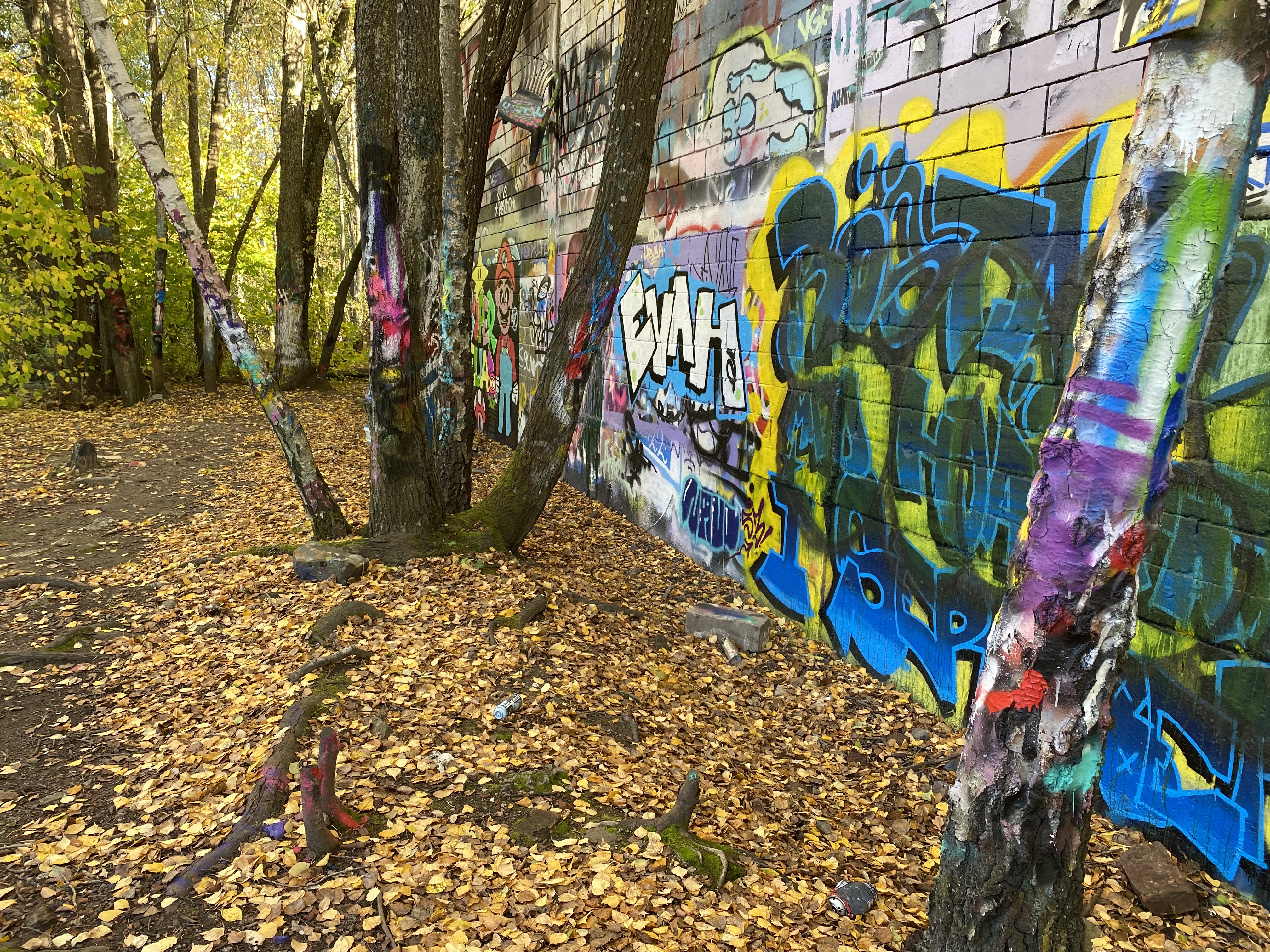
Photo: Private
Within criminology, disorder is often associated with decline, danger, or deviance. Theoretical frameworks such as the Broken Windows Theory suggest that visible signs of disorder — litter, graffiti, abandoned buildings — signal a lack of control and lead to escalating crime and insecurity. However, this perspective rarely captures the complex and sometimes contradictory meanings that disorder can hold for different people.
My doctoral research explores this ambiguity through the case of Snösätra, a former storage
zone in the southern outskirts of Stockholm. While officially designated for storage use since 1958 the dilapidated site has been used in a range of informal and unregulated ways: people have lived there, built without permits, organised rave parties and festivals, and transformed the walls into large graffiti canvases.

Through interviews with a broad range of stakeholders — e.g. graffiti writers, municipal
officials, party and festival organizers, and local police — I examine how disorder is
experienced, interpreted, and negotiated in everyday practice. A central concept in my work
is indeterminacy: that which resists clear categorization. Snösätra is not clearly legal or
illegal, clean or contaminated, permanent or temporary, valued or discarded. This
indeterminacy relates to notions of disorder and shapes social life in Snösätra.
For some, especially those involved in subcultural or artistic practices, Snösätra is at times
described as a free zone, illuminating how the absence of rules opened the space for
experimentation and inclusion. One person described it as “a perfection of chaos and
creativity”, where people could do whatever they wanted without formal oversight. In this
framing, disorder and the decaying environment is not a threat — it is an opportunity and a
signal that the space was open for reinterpretation.
In contrast, for those tasked with overseeing the site, Snösätra is a source of persistent
concern. Police and municipal workers cite environmental contamination, unstable and unsafe buildings, “spillover” of noise and graffiti, and the difficulty of maintaining order. One police officer described it as “a textbook example” of the Broken Windows theory: “you throw some cans in one place, then a broken car comes, then a stolen trailer,” and so on. The deterioration is seen not just as unsightly, but as a sign of deeper problems.
While some embrace the site’s ambiguity, for others it is a space that constantly demands
“cleaning up,” yet never stays clean. Managing Snösätra is an ongoing task of removing
abandoned vehicles, repairing fences, and preventing new informal uses from emerging. It
becomes a form of maintenance without end, reflecting the challenge of governing an
indeterminate space.
Ultimately, Snösätra reveals how disorder is not a fixed condition but a relational and
contested concept — shaped by competing visions of what urban spaces should be, and who gets to define them. It is both a threat and a refuge, a problem and a possibility.
About the author
Siri Haavimb is a phd student at the Department of Criminology at Stockholm
University, with an interest in critical perspectives on urban space.
https://www.su.se/english/profiles/siha0049-1.309678
