
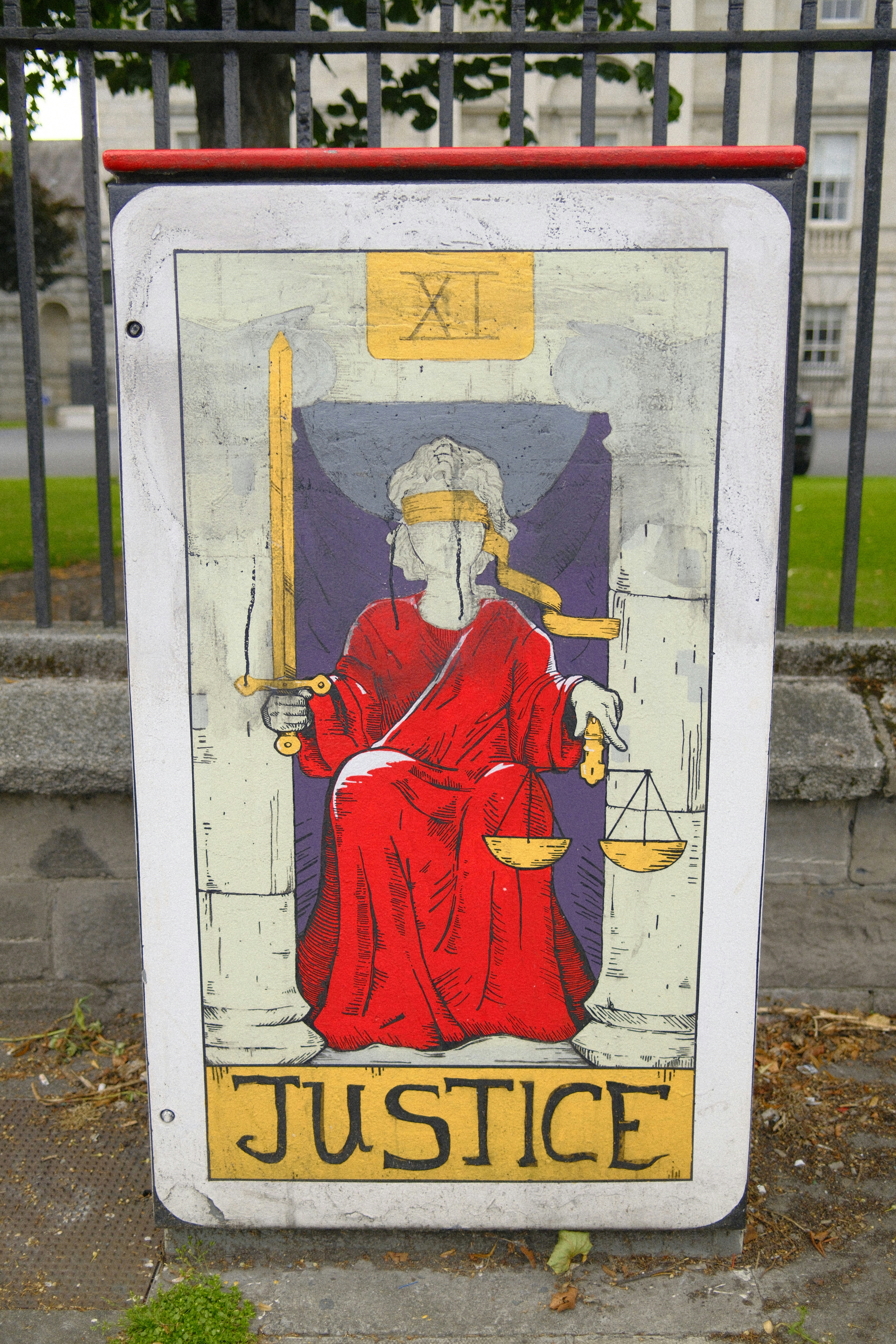
Photo by Joshua S. on Unsplash
A frequently reiterated claim in the legal literature is that the general sense of justice (abbreviated to GSJ) plays a significant role in the legislative process, particularly within the field of criminal law, most notably as a justification for harsher penalties and other repressive measures. The GSJ has a legitimising function insofar as legislators may invoke it to justify reforms on the basis of more or less vague references to the popular will.
A pertinent question is whether it is at all possible to speak of one (shared/common) sense of justice, or whether – in reality – there are in fact several such notions depending on different population groups. The very reason why it is of importance to take the GSJ into account is the fact that we live in a representative democracy. Law ought to translate the views of the people into practical policy. Politics pursued without popular support cannot, therefore, be justified – a principle which applies also to criminal policy.
In an ideal state of affairs, legislators/politicians should reflect the GSJ, given that parliamentary decisions constitute an expression of the popular will, which itself is the very source of public authority. However, the prevailing opinion among members of parliament is by no means a self-evident reflection of what people at large actually think.
It is also worth asking whether the GSJ can at all constitute an independent legal argument. The fact that legislation may consist of a popular sense of justice – expressed and invoked as a legitimate political argument – does not mean that the concept ought to be immune from critical evaluation. A legitimate question is how legislators should respond in the not at all unlikely scenario that the popular sense of justice would prove to be “wrong”.
The GSJ does indeed serve a function, provided it is taken seriously, not as an empirical reality but as an ideal. The GSJ, if it is to have any right of existence as an argument for criminal legislation, must serve as the people’s corrective to the legislator. Such a stance thus presupposes that the GSJ operates bidirectionally and not merely as a basis of legitimacy for legislative penal tightening. Today, however, the idea of decriminalisation by reference to the GSJ seems increasingly alien.
The question of whether references to the GSJ fulfil a theoretical or rather an ideological function is of interest from a criminal policy perspective. It has been noted that the GSJ appears to be a “legal fiction”, and that it is primarily a mode of argument serving a legitimising purpose.
The circumstance that the content of the GSJ cannot be clearly established is problematic, given that it is frequently employed as a basis for legislative change. If the substantive content of an argument cannot be determined, it becomes practically impossible to refute. Legislators should therefore, as a matter of principle, be cautious about basing rules on arguments concerning what the GSJ purportedly demands.
LL.D. Andreas Anderberg is a senior lecturer in criminal law at the University of Gothenburg. This blogpost is based upon his article in Nordisk Tidsskrift for Kriminalvidenskab, published in 2020, where relevant references can be found. Contact: andreas.anderberg@law.gu.se https://www.gu.se/om-universitetet/hitta-person/andreasanderberg
